Part II: Machine Learning for Theorem Proving
University of Edinburgh
ICML 2026 Tutorial — Proving Theorems with Lean and Machine Learning

With support from

Where we are
Part I, in one line: Rémy showed you Lean as a proof language — how humans write trusted ML-theory proofs.
Part II flips the arrow: machines writing the proofs.
-
The game of theorem proving: history & methodology
-
Success stories
-
Overview of approaches & benchmarks
-
Limitations & the near future
-
Demonstration + wrap-up
Why should an ICML audience care?
-
Verified reward: theorem proving is the rare domain with a perfect, cheap, automatic reward signal — a paradise for RL and test-time search.
-
Frontier capability benchmark: IMO gold (2025), Putnam 12/12, first research-level results — progress is fast and measurable.
-
You can use it today: AI copilots for formalising your own ML theory.
Could your next ML theory paper come with a machine-checked appendix?
§1 · Theorem proving in Lean as a game
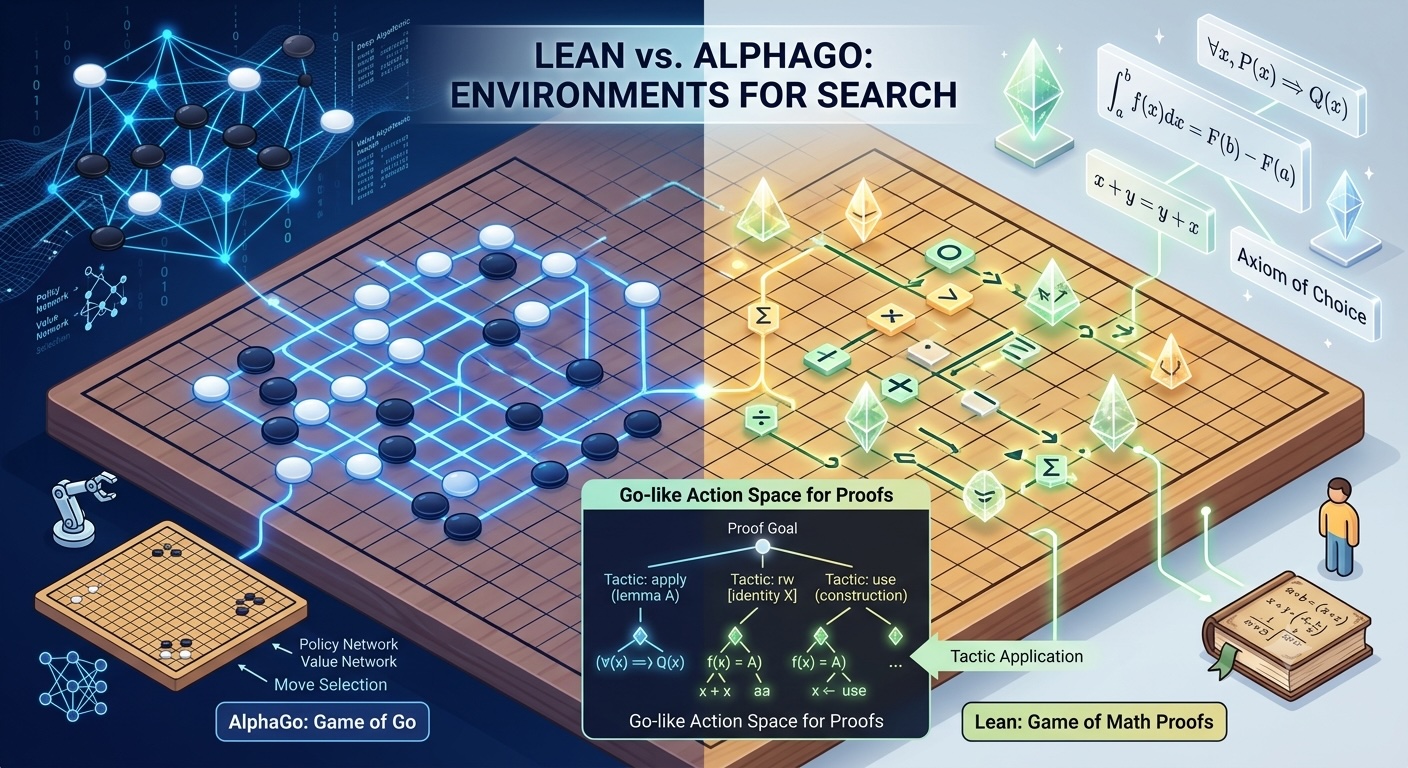
The "AlphaGo for mathematics" framing — with a twist:
the action space is infinite, and the "board" is a proof state (or state of Lean).
A brief history: symbolic → neural
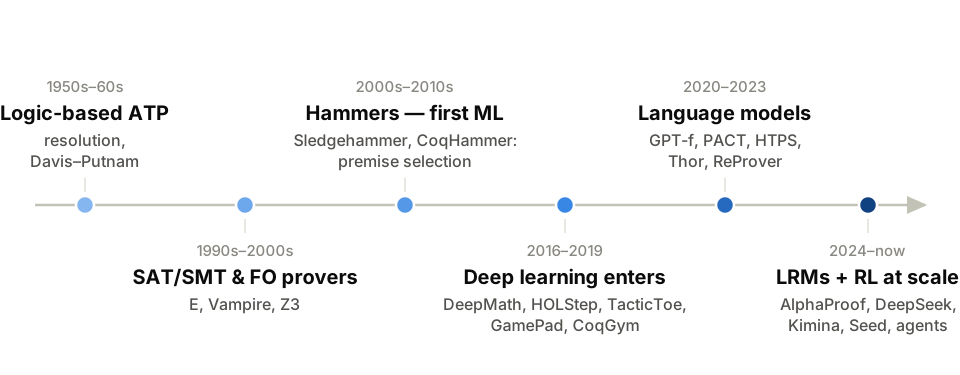
Takeaway: ML for theorem proving is older than the LLM era — but the LLM era changed everything.
Classical ML tasks in theorem proving
-
Premise selection: from a 200k-theorem library (Mathlib), retrieve the lemmas relevant to the current goal — k-NN → DeepMath → LeanHammer · LeanSearch · Moogle.
-
Tactic selection / step prediction: given a proof state, predict the next tactic and its arguments.
These two tasks are the interfaces where ML plugs into an interactive prover.
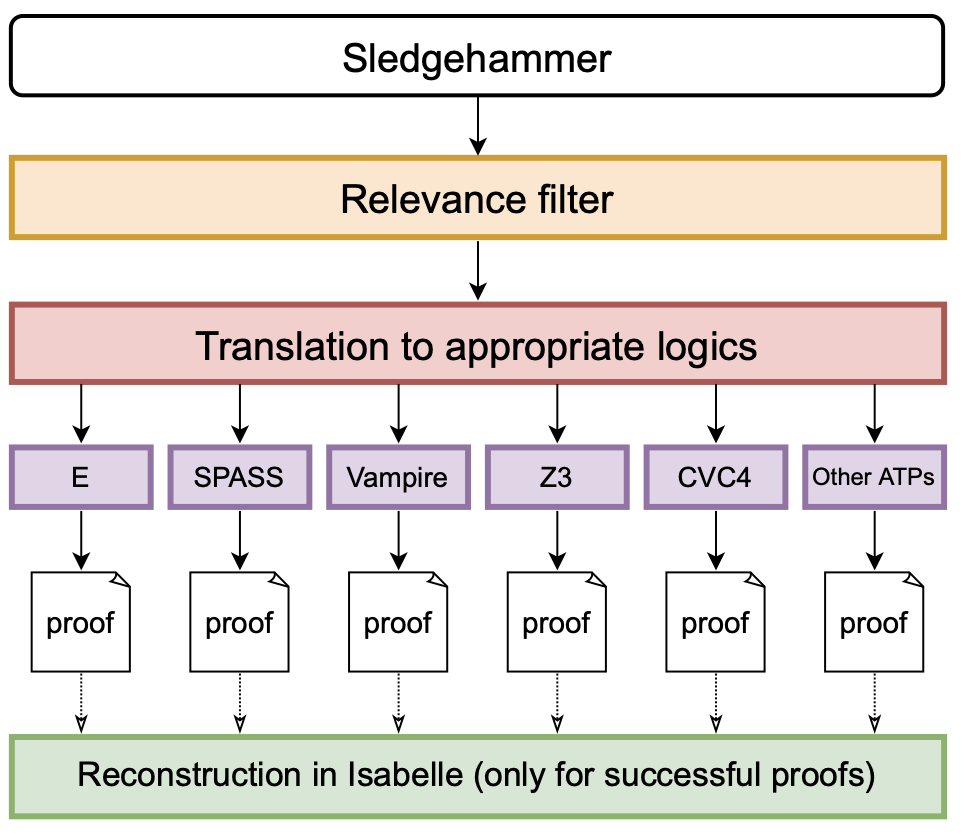
Sledgehammer pipeline — from Magnushammer (Mikuła et al., 2023)
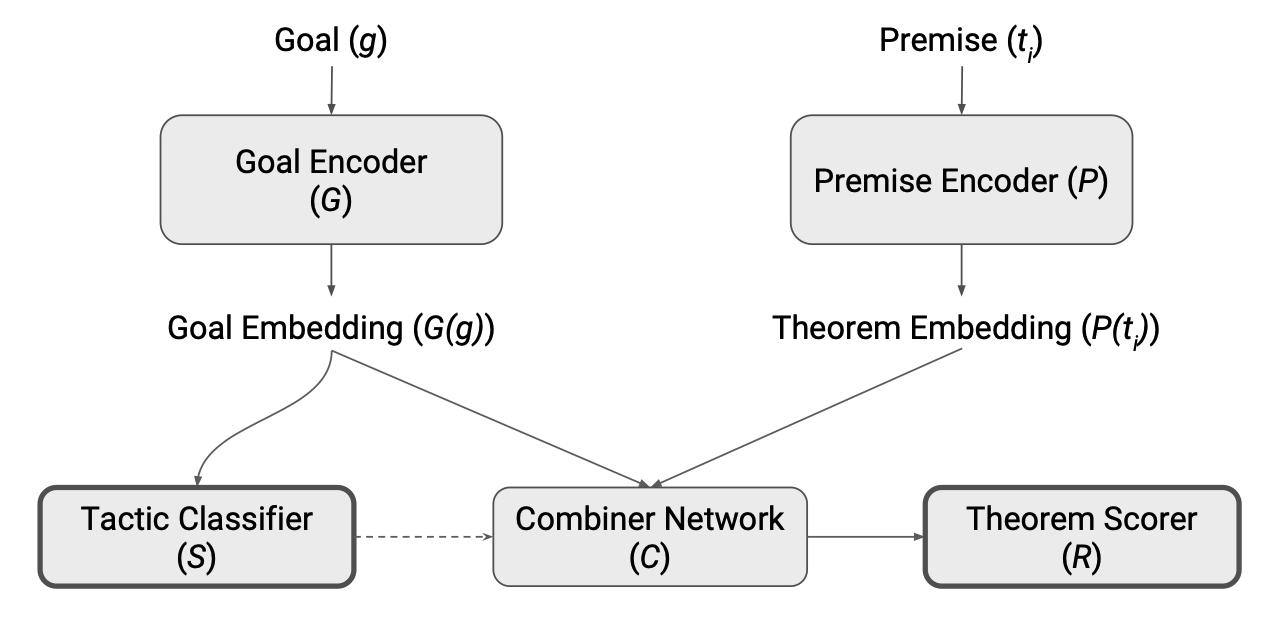
HOList / DeepHOL — Bansal et al. (ICML 2019)
Tactic prediction + proof search
A proof assistant is a game engine — state: local context + goal(s); action: a tactic; terminal reward: kernel accepts ⇒ 1, else 0 — no false positives.
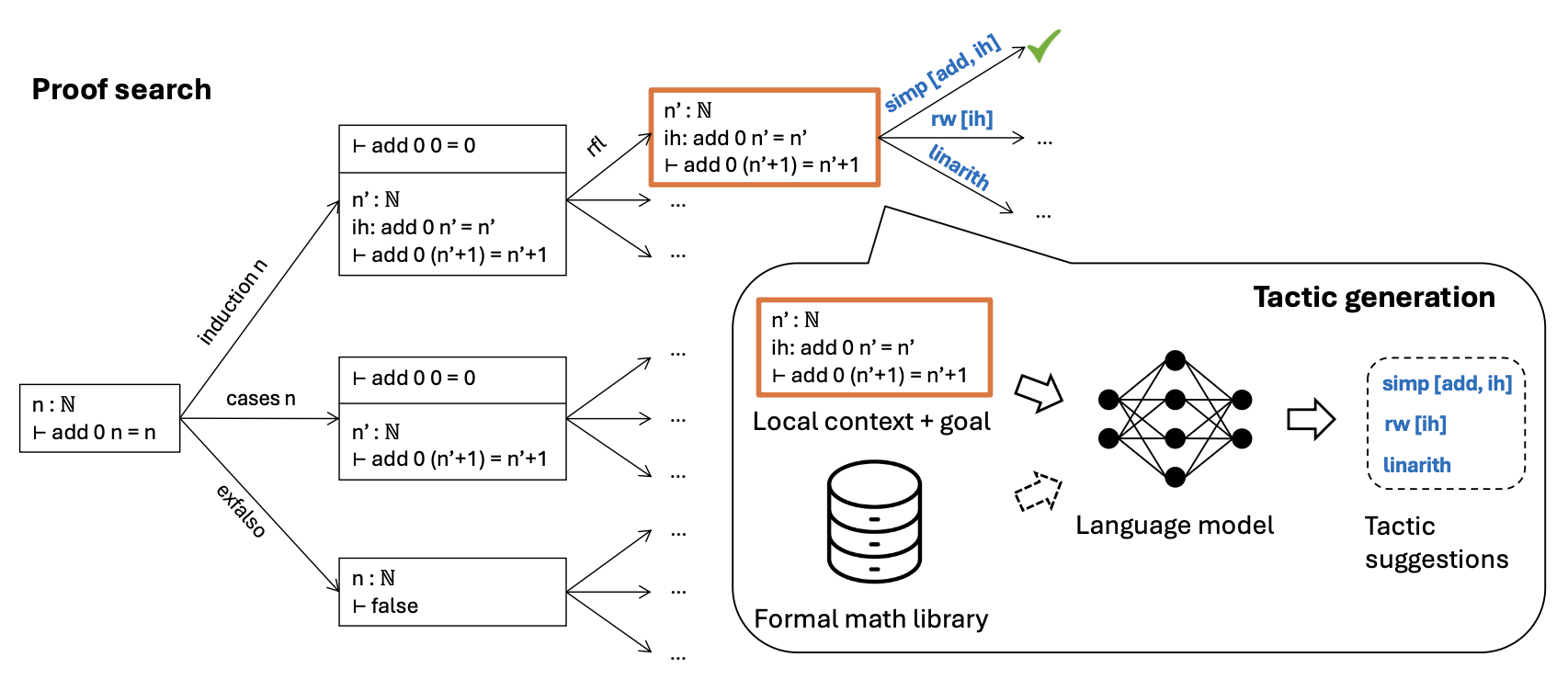
Yang et al., "Formal Mathematical Reasoning: A New Frontier in AI" (2024)
theorem zero_add (n : Nat) : 0 + n = n := by
case zero => rfl
case succ n' ih => simp only [Nat.add_succ, ih]
The core loop: agent–prover interaction
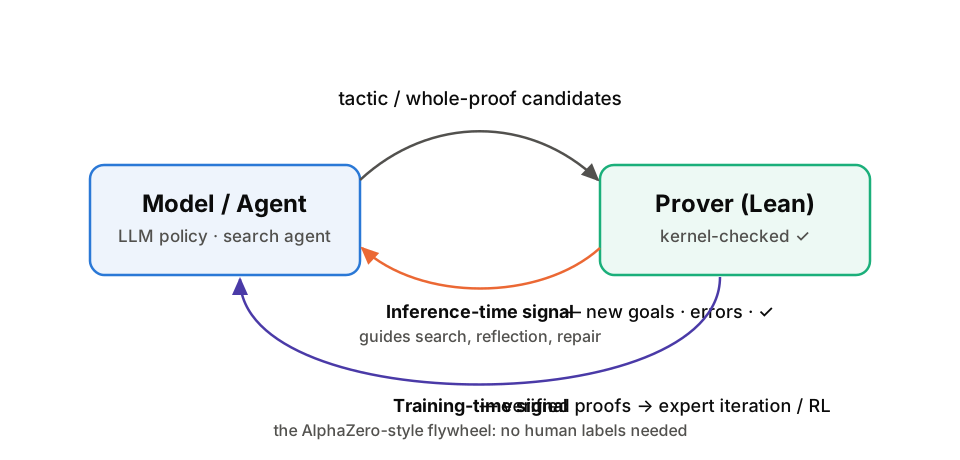
Everything in §3 is an instance of this loop with different design choices.
§2 · How far have we come?
miniF2F pass rate:
≈29% (GPT-f/PACT, 2021) → 99.6% (Seed-Prover, Jul 2025)
— with AlphaProof scoring perfect on miniF2F-valid along the way (test-time RL; Nature 2025).
The yardstick of the field for four years — now saturated.
AlphaProof: silver at IMO 2024
What it did:
-
4/6 problems, 28/42 — one point below the gold cutoff.
-
Solved P1, P2, and P6 (hardest; only 5 human contestants solved it); AlphaGeometry 2 solved P4 in 19 s; both combinatorics problems unsolved.
How:
-
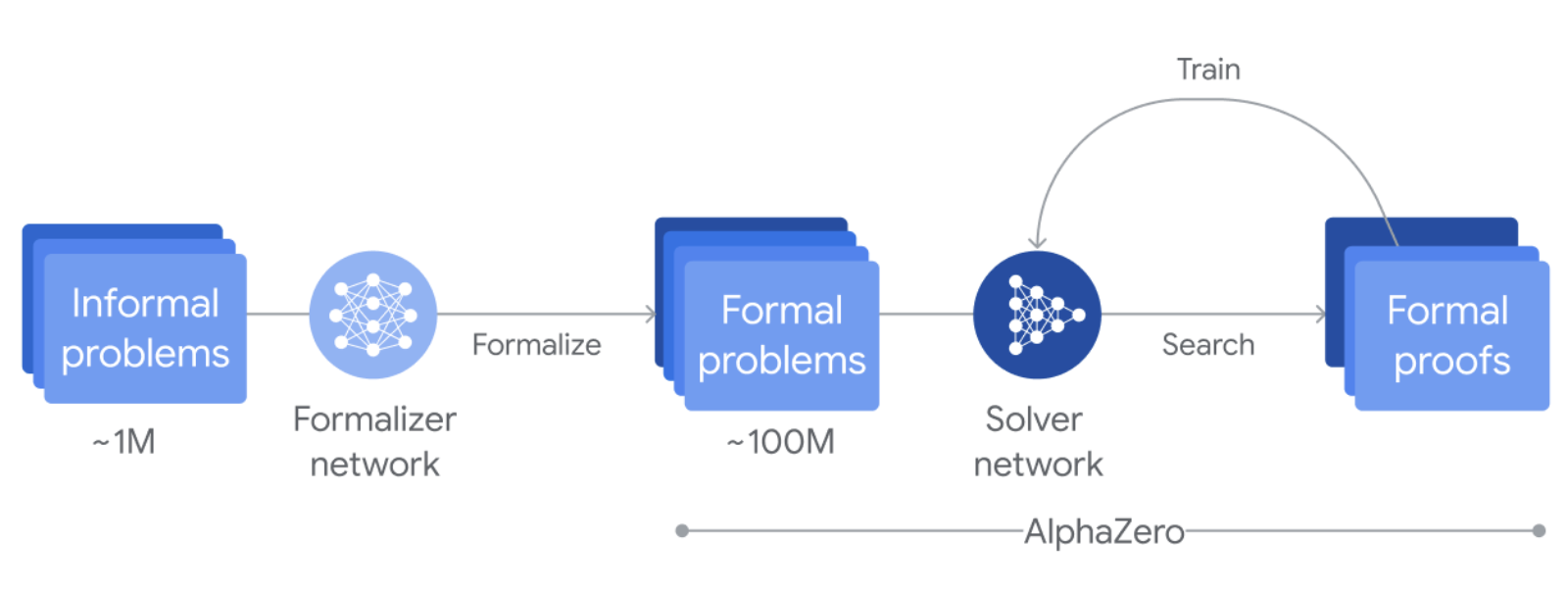
AlphaZero-style RL over Lean; ~1M informal problems autoformalised into ~80–100M formal statements as the RL curriculum.
-
Test-time RL: generating and proving variants of the target problem — minutes for one problem, up to three days for the others.
Honest caveats: days per problem (humans get 2×4.5 h); statements manually formalised by humans. Peer-reviewed: Nature, Nov 2025.
IMO 2025: formal gold — and the fine print
-
Aristotle (Harmonic): gold-level — P1–P5 with Lean-verified proofs (35/42); announced after honouring IMO's embargo. P6 unsolved by every AI system.
-
Seed-Prover (ByteDance): official, IMO-confirmed 30/42 = silver within its 3-day window; lemma-style whole-proof generation.
-
Informal golds, both 35/42: Gemini Deep Think (within the 4.5 h limit, graded by IMO coordinators) and an OpenAI experimental model (self-graded, not IMO-certified).
-
Why formal matters — and the fine print: formalised inputs, extended compute windows, undocumented handling of "determine the answer" parts. Trust the proofs, interrogate the conditions.
IMO 2026 is July 15–16 in Shanghai — right around this tutorial. Expect fresh results.
Putnam 2025: the next domino
Live Putnam 2025 (Dec 6, 2025), all Lean-verified after the fact:
-
AxiomProver: 12/12 — 8 within the exam window, 4 over the following days.
-
Numina-Lean-Agent (open-source harness): 12/12 — Claude Code + Lean MCP, benchmarked after the exam.
-
Seed-Prover 1.5: 11/12 within 9 h. Aristotle: 10/12 — via the consumer product, run by an outside user.
-
Informal reference (MathArena, graded blind by official Putnam graders): best agentic model 103/120 — top-3-human territory.
The PutnamBench trajectory
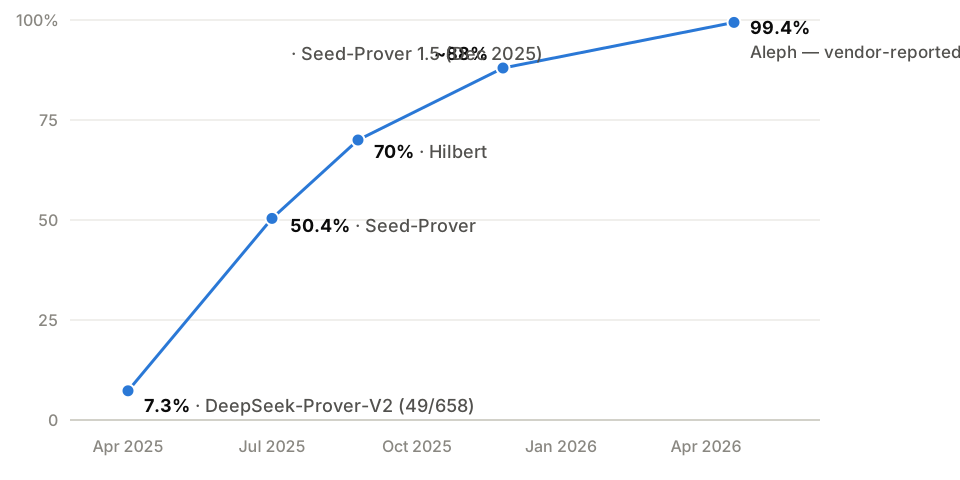
Competition math has effectively fallen — in about 18 months.
Beyond competitions: AI discovers new mathematics
The unit-distance problem falls (May 20, 2026): an internal OpenAI reasoning model
produced an original construction disproving Erdős's ~80-year-old planar
unit-distance conjecture — point sets with n^{1+\delta} unit distances.
-
The construction imports class field towers and Golod–Shafarevich — a genuinely different corner of mathematics; within days, Will Sawin refined it to an explicit exponent
\delta \approx 0.014.
The Lean follow-up — verification catching up to discovery:
-
Aleph Prover: a 33,087-line Lean 4 formalisation 8 days after the announcement — modulo two classical results taken as trusted assumptions.
-
Parallel community + AI effort on the Lean Zulip: a fully-from-the-axioms formalisation, still in progress as of late June.
An AI system found the mathematics; formal proof is how we trust it at this speed.
Beyond competitions: research mathematics at scale
-
Sphere packing in dimensions 8 & 24 (Math Inc., Dec 2025): the autoformalisation agent Gauss, with the existing project team, finished the Lean formalisation of Viazovska's Fields-Medal proofs — dim 8 in 5 days, dim 24 in ~2 more weeks. The human team had estimated ~6 months for dim 8 alone.
-
De Giorgi–Nash–Moser theory (Armstrong & Kempe, Apr 2026): a central chapter of modern PDE regularity theory — ~56,000 lines of Lean in about two weeks, with LLM agents writing all the Lean ("no human hand touched the Lean files").
-
Quantitative stochastic homogenisation (Armstrong & Kuusi, Jun 2026): the same workflow applied to their own current research paper — formalisation keeping pace with the research frontier.
Honest framing: the mathematics + proof architecture came from humans; AI removed the formalisation cost barrier (months → days).
Beyond mathematics: AI-authored verified software
The same recipe is spilling into program verification — proving code correct.
-
lean-zip (Kim Morrison, 2026) — a fully verified DEFLATE / gzip / ZIP codec in Lean 4, with
inflate (deflate data) = ok dataproved for every input: ~32,000 lines, 1,100+ theorems, zerosorrys.-
The kicker: implementation and proofs written almost entirely by loosely-supervised AI agents working from a plan document — long-horizon agentic formalisation, not a single prover call.
-
And it's practical: 2–3× faster than OCaml's
decompress, within ~2× ofzlib.
-
-
A field organising around this: Software Verification in Lean 2026 (INRIA Paris, Apr 2026) — Lean automation (de Moura), verified SymCrypt, post-quantum crypto & TLS 1.3, specification quality.
One proving engine, two frontiers: research mathematics and trustworthy real-world software — advancing together.
What made this possible?
Three ingredients, mapping back to the core loop:
-
Verified reward at scale — Lean as an RL environment; no reward hacking on the final answer.
-
Autoformalisation closing the data gap — AlphaProof's ~1M informal → ~80–100M formal curriculum; Lean Workbook's 57k contest problems; Herald's 580k statement pairs.
-
Test-time compute — search, variants, lemma trees, days of thinking.
Let's open the hood and organise the design space.
§3 · The design space
training ↓ · interaction →
stepwise / subgoal-level
whole-proof
repository-level
trained (RL / expert iteration / SFT)
AlphaProof · HTPS · ABEL · InternLM-StepProver · BFS-Prover · DeepSeek-Prover-V1.5 · GPT-f · ReProver (LeanDojo)
Kimina-Prover · Goedel-Prover-V2 · DeepSeek-Prover-V2 · Seed-Prover · Baldur · Pythagoras-Prover · STP
Seed-Prover 1.5 · Leanstral 1.5 · Aristotle†
training-free / agentic
LLM + Lean REPL / MCP · Hilbert · Delta Prover
Draft-Sketch-Prove · LEGO-Prover
Numina-Lean-Agent · Claude / Codex + lake build
† Aristotle: per its paper, a tactic-level prover (MCGS + expert iteration) inside an agentic informal-lemma loop; it now clearly works with repositories, but that part is not in the paper.
Approach 1: stepwise RL + search
The AlphaZero recipe for proofs:
-
Policy + value networks over proof states;
-
Expert iteration on found proofs;
-
Curriculum from easy to hard.
Examples: AlphaProof, HTPS, ABEL, InternLM-StepProver.
-
Pros: dense feedback, principled search.
-
Cons: prover-in-the-loop is slow; value estimation is hard; engineering-heavy.
A GPT-f training example (Metamath):
{
"proof_label": "unidmrn",
"goal": "[[ ]] |- U. U. ‘’ A
    = ( dom A u. ran A )",
"proof_step": "[[ |- A = B |- C = B ]]
    |- A = C \\
{{ A : U. U. ‘’ A }} \\
{{ B : ( ran ‘’ A u. dom ‘’ A ) }} \\
{{ C : ( dom A u. ran A ) }}",
"proof_step_hash": "37yZVNorgF8=",
"parent_hash": ["n4Kl7judEN4="]
}
Approach 1 in action: HTPS and AlphaProof
HTPS — MCTS over proof hypertrees: selection / expansion / back-propagation.
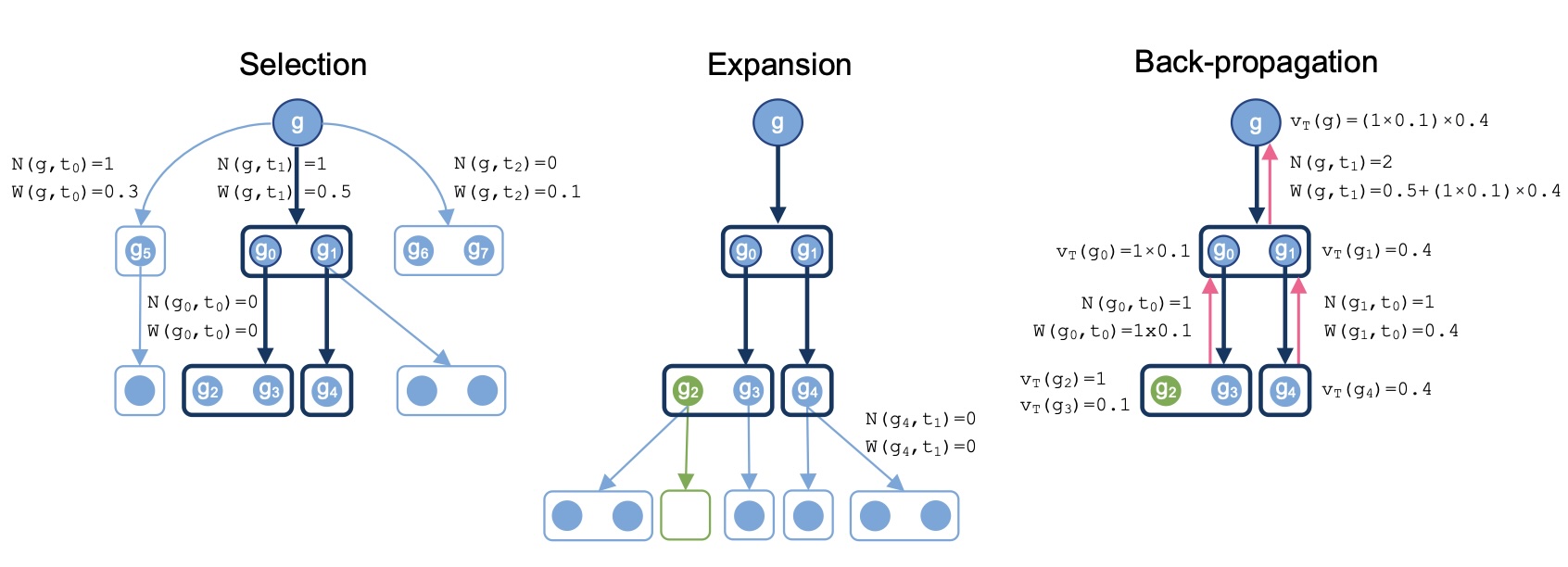
AlphaProof — the AlphaZero recipe at scale: autoformalised curriculum + search.
Approach 2: whole-proof generation with LRMs
The paradigm: treat the entire proof as a sequence — sample complete proofs, check with Lean, resample or repair on failure. Chain-of-thought / LRM reasoning made this viable: informal sketch interleaved with formal output.
Stepwise: fine-grained feedback, expensive prover interaction
Whole-proof: cheap parallel sampling, coarse feedback
The 2025 default: RL fine-tuning of reasoning models to emit complete Lean proofs.
-
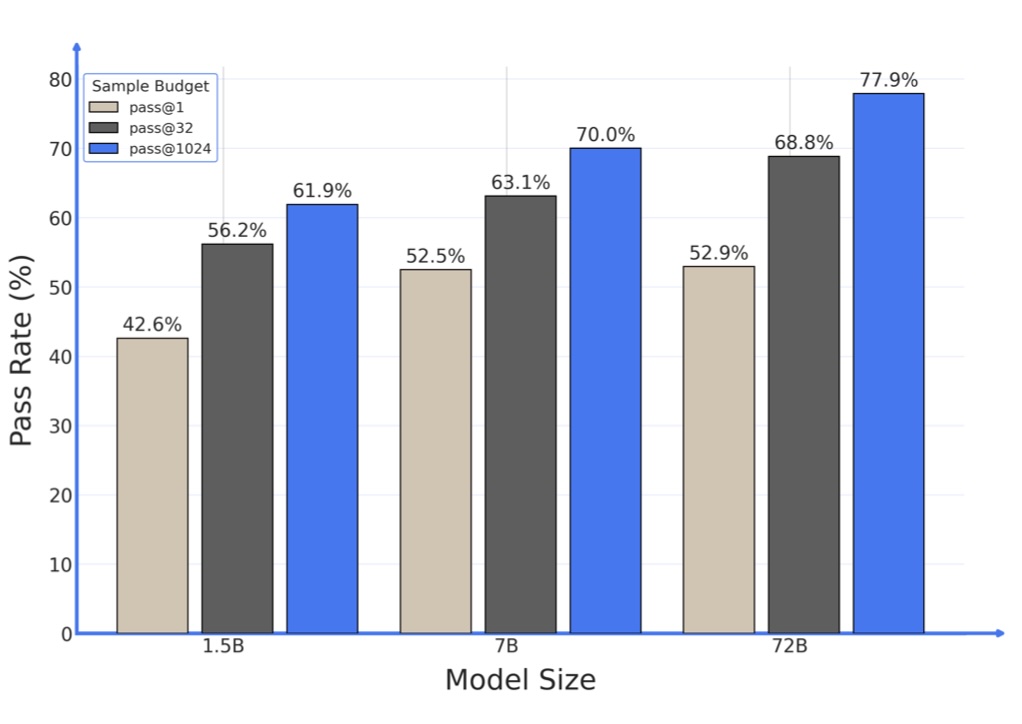
Kimina-Prover: 80.7% miniF2F preview → 92.2% with test-time search.
-
DeepSeek-Prover-V2 (671B): 88.9%; subgoal decomposition.
-
Goedel-Prover-V2: 90.4% with self-correction at only 32B — an 8B variant matches the 671B DeepSeek.
Key tricks: informal CoT before the formal proof; subgoal decomposition; sample-and-repair / self-correction loops.
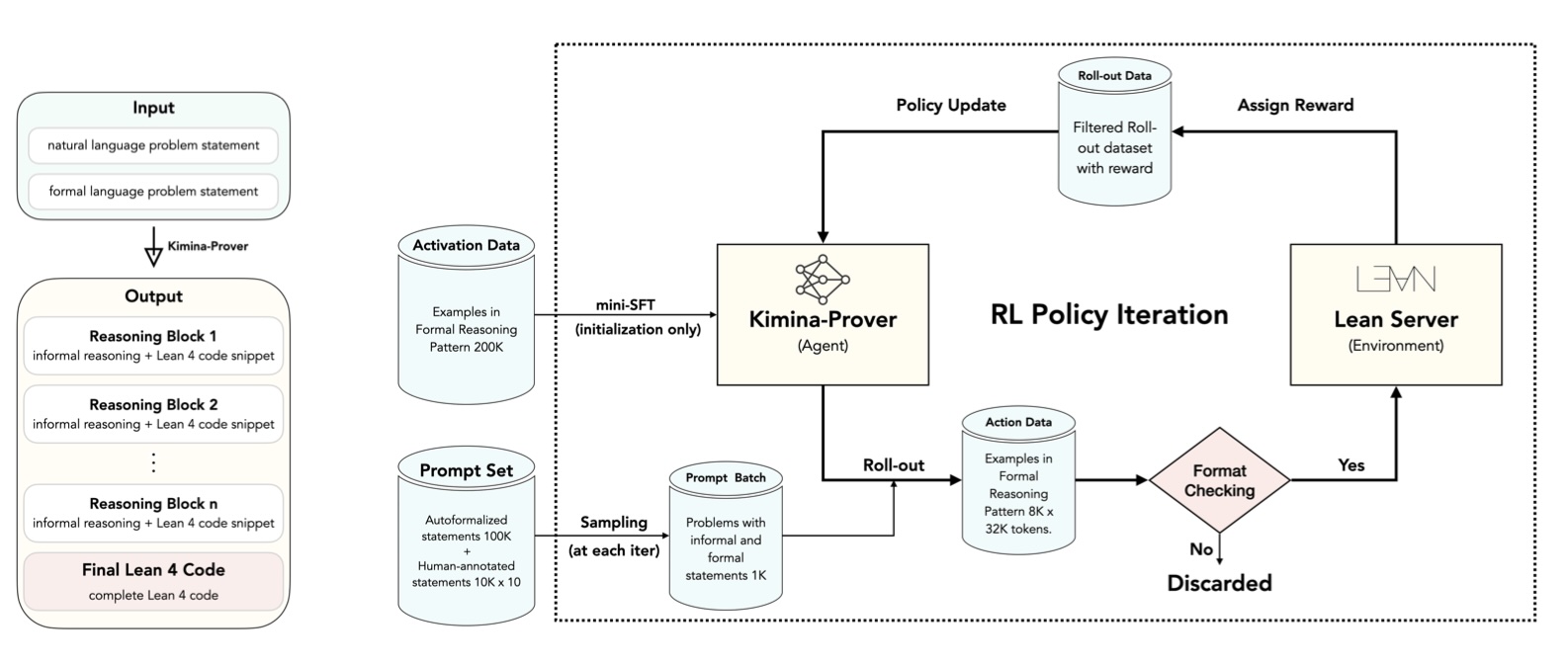
Approach 2 in action: Kimina-Prover
Reasoning-style generation + RL: informal reasoning blocks interleaved with Lean snippets; RL policy iteration against a Lean server.
Test-time scaling: pass rate grows with sample budget and model size.
Style comparison: step vs. whole-proof, same theorem
IMO 1962 P2 — "find all x with √(3−x) − √(x+1) > 1/2" (answer: −1 ≤ x < 1 − √31/8):
BFS-Prover (Approach 1) — a bare search trace; kernel-checked when found, on a 2025 Mathlib (it no longer replays):
theorem imo_1962_p2 (x : ℝ) (h₀ : 0 ≤ 3 - x) (h₁ : 0 ≤ x + 1)
    (h₂ : 1 / 2 < Real.sqrt (3 - x) - Real.sqrt (x + 1)) :
    -1 ≤ x ∧ x < 1 - Real.sqrt 31 / 8 := by
  constructor
  linarith
  rw [← sub_pos]
  field_simp [Real.sqrt_lt] at h₂ ⊢
  apply lt_of_le_of_lt
  rw [mul_comm]
  rw [sub_eq_add_neg]
  apply lt_of_le_of_lt
  rw [← lt_sub_iff_add_lt]
  ring_nf
  rw [← lt_sub_iff_add_lt]
  linarith [Real.sq_sqrt (by linarith : 0 ≤ 1 + x)]
  rw [Real.sqrt_lt (by norm_num)]
  rw [Real.sqrt_lt] <;> nlinarith
  norm_num at this
Kimina-Prover (Approach 2) — one pass:
a have chain, every leaf an nlinarith with hand-fed hints:
theorem imo_1962_p2 (x : ℝ) (h₀ : 0 ≤ 3 - x) (h₁ : 0 ≤ x + 1)
(h₂ : 1 / 2 < Real.sqrt (3 - x) - Real.sqrt (x + 1)) :
-1 ≤ x ∧ x < 1 - Real.sqrt 31 / 8 := by
have h3 : -1 ≤ x := by
nlinarith
have h4 : Real.sqrt (3 - x) - Real.sqrt (x + 1) > 1 / 2 := by linarith
have h5 : Real.sqrt (x + 1) ≥ 0 := Real.sqrt_nonneg (x + 1)
have h6 : (7 / 4 - 2 * x) > Real.sqrt (x + 1) := by
nlinarith [Real.sq_sqrt (show (0 : ℝ) ≤ 3 - x by linarith),
Real.sq_sqrt (show (0 : ℝ) ≤ x + 1 by linarith),
Real.sqrt_nonneg (3 - x), Real.sqrt_nonneg (x + 1)]
have h7 : (7 / 4 - 2 * x) ^ 2 > (Real.sqrt (x + 1)) ^ 2 := by
nlinarith [h6, Real.sqrt_nonneg (x + 1)]
have h8 : (7 / 4 - 2 * x) ^ 2 > x + 1 := by
have h10 : (Real.sqrt (x + 1)) ^ 2 = x + 1 := by
rw [Real.sq_sqrt]
linarith
nlinarith [h7, h10]
have h9 : 64 * x ^ 2 - 128 * x + 33 > 0 := by
nlinarith [h8]
have h10 : x < 1 - Real.sqrt 31 / 8 := by
by_contra hx
push_neg at hx
have h12 : Real.sqrt 31 > 0 := by
apply Real.sqrt_pos.mpr
norm_num
nlinarith [sq_nonneg (x - (1 - Real.sqrt 31 / 8)), sq_nonneg (Real.sqrt 31),
Real.sq_sqrt (show (0 : ℝ) ≤ 31 by norm_num), h12]
exact ⟨h3, h10⟩
Approach 3: growing & reusing lemmas
One mechanism, two timescales — build a pool of intermediate lemmas and reuse them:
-
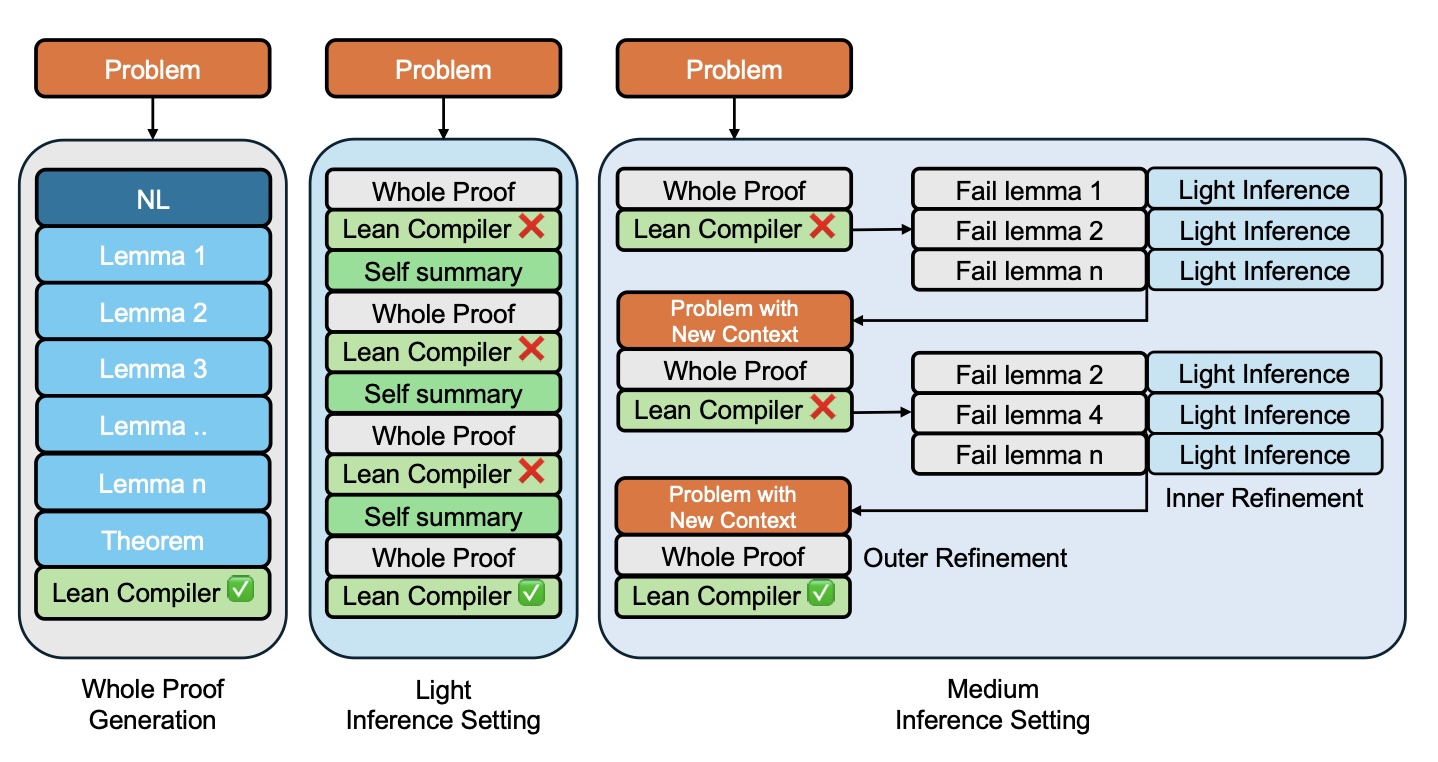
Within a single problem (test-time / lemma-style): Seed-Prover's conjecture/lemma pool with iterative refinement — training-style compute spent on one target at inference time.
-
Across problems (library learning & self-play): STP's conjecturer ↔ prover self-play; LEGO-Prover's skill library; retrieval-augmented proving (ReProver).
Unifying point: it is literally the same object on both sides — mathematics is cumulative, and reuse makes per-problem proving compound instead of restarting every time.
LEGO-Prover's growing skill library:
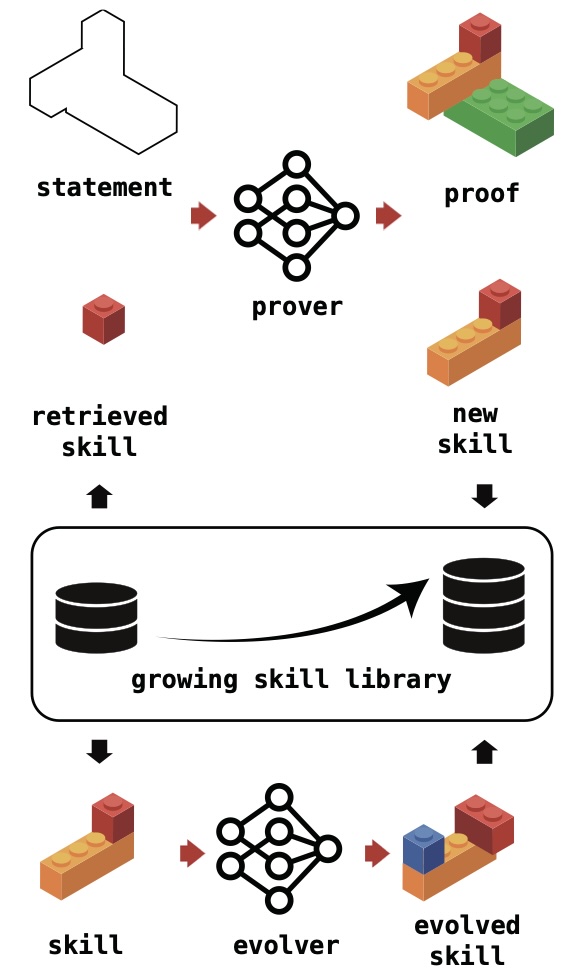
Cost honesty: the test-time / self-play end is the most expensive corner of the design space.
Approach 3 in action: lemma pools & skill libraries
Across problems — STP: conjecturer ↔ prover self-play:
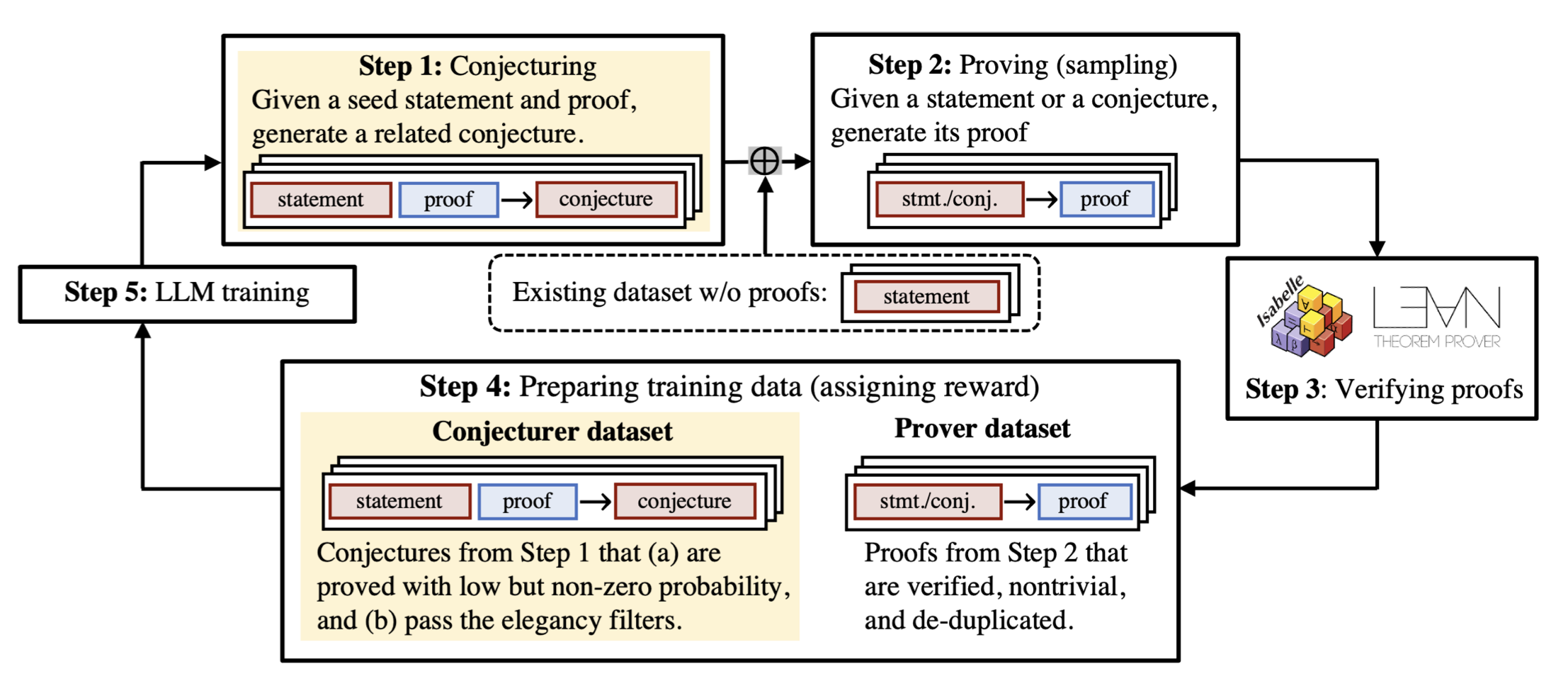
Within a problem — Seed-Prover's lemma-style refinement:
Approach 4: training-free & agentic proving
As base LLMs got stronger, "no fine-tuning" became competitive:
-
Delta Prover: decomposition + iterative reflection — 95.9% miniF2F with an off-the-shelf model.
-
Hilbert (Apple): recursive informal-reasoning + formal-proof construction — 70% PutnamBench (SOTA at release, Sep 2025; since surpassed).
-
Agentic scaffolds: Numina-Lean-Agent (Claude Code + Lean MCP), Aristotle-as-product, general LLM + Lean REPL tool use.
Discussion point: will scaffolds keep beating bespoke fine-tuning as frontier models improve? — the "bitter lesson at test time" question.
Approach 4 in action: Hilbert and Numina-Lean-Agent
Hilbert — recursive decomposition: prover ↛ shallow solve ↛ subgoal decomposition, recurse.
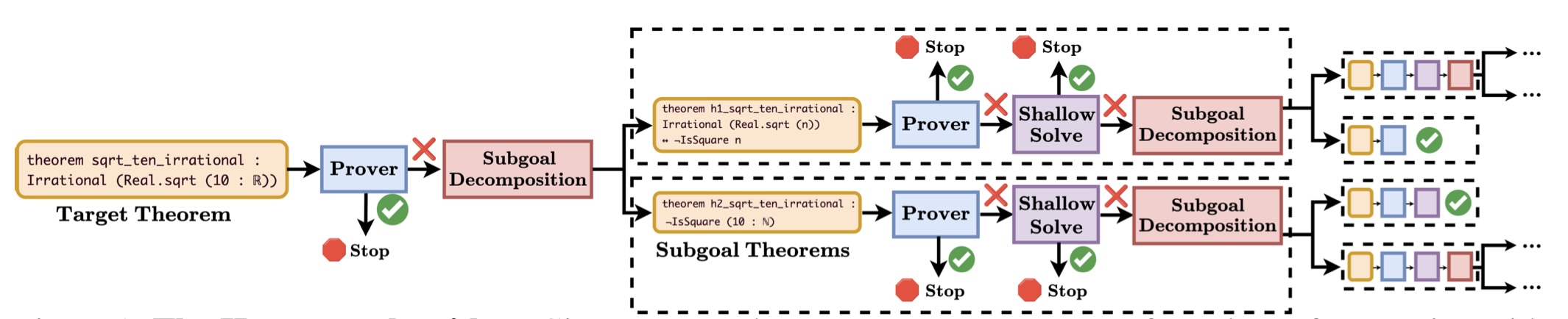
Numina-Lean-Agent — a coding agent + Lean MCP tools: kernel feedback, retrieval, informal proving, discussion.
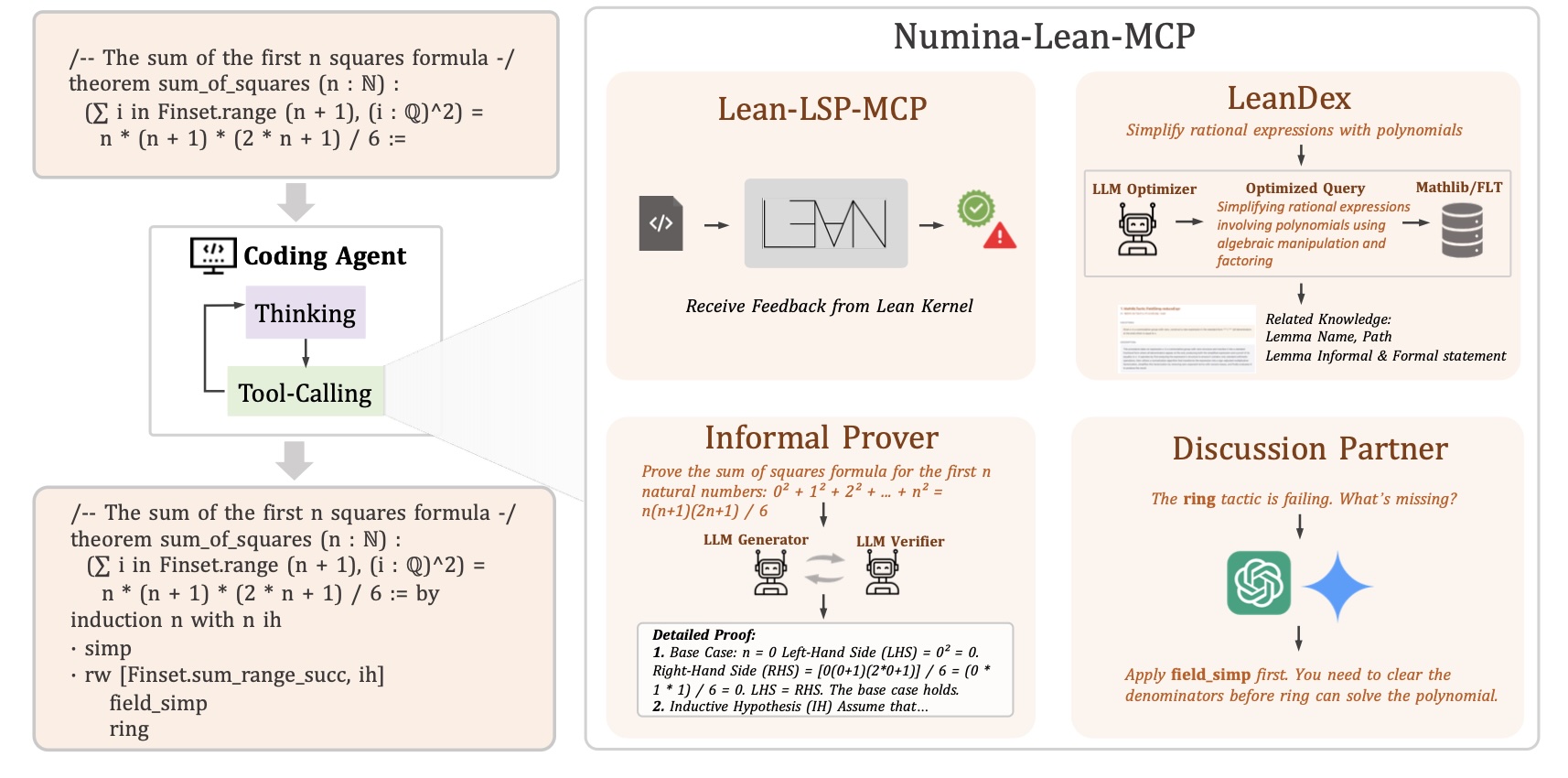
Benchmarks: competition math is saturated
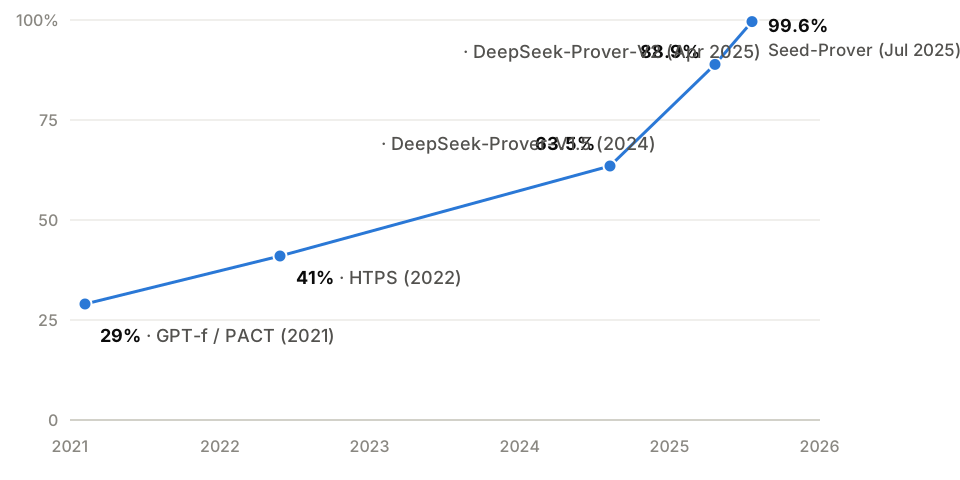
-
miniF2F (488 problems) saturated: 99.6%. PutnamBench (672 problems): 50% → 99.4% in under a year.
-
The frontier has moved to research-level problems, where numbers collapse:
-
FATE (research-level algebra): at release, best system 3% on FATE-H, 0% on FATE-X — while informal reasoning on the same problems scores 71%/33%. Formalisation, not reasoning, is the bottleneck.
-
Formal Conjectures (DeepMind): 2,615 statements incl. 1,029 open conjectures — contamination-free by construction.
-
Benchmarks: program verification in Lean
A fast-growing benchmark family where the theorem is "this program meets its spec":
-
Verified code generation — model writes implementation + spec + proof:
-
CLEVER (161, HumanEval-derived): anti-shortcut curation — no test-case supervision or LLM-written specs; generated specs must be proved equivalent to hidden ground truth.
-
Verina (189): end-to-end from natural language — code, spec, and proof, each graded separately.
-
VeriSoftBench (≈500): repository-scale — whole verified Lean repos with dependencies, not isolated functions.
-
FVAPPS (4,715): the largest — competitive-programming tasks with auto-generated specs as
sorrytheorems.
-
-
Proving verification conditions from deployed code:
-
NTP4VC (600 VCs, from 7.5k+ candidates): real kernel code (Linux, Contiki) through Why3/Frama-C, rendered in Lean, Isabelle, and Rocq.
-
Constructions differ widely — spec provenance, scale, granularity — so read the construction before the leaderboard.
Where we stand
training ↓ · interaction →
stepwise / subgoal-level
whole-proof
repository-level
trained (RL / expert iteration / SFT)
AlphaProof · HTPS · ABEL · InternLM-StepProver · BFS-Prover · DeepSeek-Prover-V1.5 · GPT-f · ReProver (LeanDojo)
Kimina-Prover · Goedel-Prover-V2 · DeepSeek-Prover-V2 · Seed-Prover · Baldur · Pythagoras-Prover · STP
Seed-Prover 1.5 · Leanstral 1.5 · Aristotle†
training-free / agentic
LLM + Lean REPL / MCP · Hilbert · Delta Prover
Draft-Sketch-Prove · LEGO-Prover
Numina-Lean-Agent · Claude / Codex + lake build
† Aristotle: per its paper, a tactic-level prover (MCGS + expert iteration) inside an agentic informal-lemma loop; it now clearly works with repositories, but that part is not in the paper.
-
The trend: tactic-level → repository-level. Academia mostly explores repo-level scaffolds; industry may attempt repo-level training.
-
Tactic/whole-proof training is still worth exploring: proving with extremely small models (Pythagoras-4B beats the 671B DeepSeek), advanced tactic usage (e.g.
grind), canonical proof formats.
§4 · Coping with a flood of machine proofs
AI can now generate verified formal proofs by the thousand.
The frontier question is no longer "can a machine prove it?" but what humans still have to do:
-
Can we trust the proofs? (reward hacking)
-
Who supplies the definitions?
-
Can we read & maintain what the machine emits?
Limitation 1: can we trust the flood?
The reward is "the kernel accepts" — but an agent optimising hard finds cracks:
-
Gaming the harness, not the kernel — DeepSeek-Prover-V2:
apply?inserts a "synthetic sorry" whose warning gets suppressed by an unrelated error — a pipeline that only checks "no errors, nosorry" accepts a bogus proof (analysis: Thomas Zhu). -
Extending the trusted base —
native_decidepulls the Lean compiler + C++ runtime into the TCB; a past kernel soundness gap (since patched) failed to flag it.#print axiomsis the audit.
A "perfect verifier" is only as trustworthy as the harness around it — and an RL objective will find every gap.
How humans cope: #print axioms audits; Comparator & SafeVerify — sandboxed
re-checking against a trusted statement file; independent kernel implementations,
raced on lean-kernel-arena.
Limitation 2: definitions & problem formulation
The prover proves the statement you write, not the one you mean — and Lean's
totality conventions ("junk values": x / 0 = 0, Real.sqrt (-1) = 0) make it easy
to state something else entirely, then cheerfully verify it.
The Riemann Hypothesis: Loeffler & Stoll's formal RH read "if s is not a
negative even integer and ζ(s) = 0 then Re(s) = 1/2." Buzzard & Ellenberg
asked: what about s = 1, ζ's pole? Totality hands riemannZeta 1 a junk
value — had it been 0, the statement would be trivially false, and not RH.
By luck it is ½(γ − log 4π) ≈ −0.98 — now certified by
riemannZeta_one_ne_zero. Whether the statement was RH hinged on an
unexamined junk value.
Everyday version: ∀ n m : ℕ, (n - m) + m = n silently drops n ≥ m
(truncated subtraction) — and vacuous misformalisations: contradictory
hypotheses prove anything.
Mathematics is largely about choosing definitions & abstractions — which current systems essentially can't. A machine-checked ✓ certifies the proof — never that you asked the right question.
Limitation 3: proofs humans can't read or maintain
Generation optimises for compile, not for library-quality:
-
LLM proofs are "less readable, modular, maintainable, and reusable than proofs in mature libraries" — systems "prioritize compilation above all else" → monolithic, ad-hoc scripts.
-
At library scale: a mergeable Mathlib lemma must be non-redundant, at the right generality, consistently named, in accepted style — "bulk-submitting AI proofs imposes substantial review burden."
-
Already real: ~2.3k open PRs awaiting review from ~30 maintainers — a human review budget that AI-generated volume overwhelms.
-
The community is drawing lines: Mathlib's policy — AI code without Lean-expert supervision "fails Mathlib's standards"; low-quality LLM PRs are closed summarily; repeat offenders lose PR and Zulip access.
Being worked on: proof-refactoring agents, style-aware rewards, lemma extraction; benchmarks that measure the gap — APE-Bench (best agent ≈47%, cost-capped pass@1).
Generating a proof ≠ producing maintainable mathematics — merely-correct is not mergeable.
Limitation 3, concretely: the Mathlib standard
The bar a contribution must meet — Euclid's infinitude of primes, as it lives
in Mathlib/Data/Nat/Prime/Infinite.lean:
/-- Euclid's theorem on the **infinitude of primes**.
Here given in the form: for every `n`, there exists a prime number `p ≥ n`. -/
theorem exists_infinite_primes (n : ℕ) : ∃ p, n ≤ p ∧ p.Prime :=
let p := minFac (n ! + 1)
have f1 : n ! + 1 ≠ 1 := Nat.ne_of_gt <| succ_lt_succ <| factorial_pos _
have pp : p.Prime := minFac_prime f1
have np : n ≤ p :=
le_of_not_ge fun h =>
have h₁ : p ∣ n ! := dvd_factorial (minFac_pos _) h
have h₂ : p ∣ 1 := (Nat.dvd_add_iff_right h₁).2 (minFac_dvd _)
pp.not_dvd_one h₂
⟨p, np, pp⟩
/-- A version of `Nat.exists_infinite_primes` using the `BddAbove` predicate. -/
theorem not_bddAbove_setOf_prime : ¬BddAbove { p | Nat.Prime p } := by
rw [not_bddAbove_iff]
intro n
obtain ⟨p, hi, hp⟩ := exists_infinite_primes n.succ
exact ⟨p, hp, hi⟩
-
Documented; every step a named lemma (
minFac_prime,dvd_factorial) — names follow a grammar, so they can be guessed and found. -
Ten readable lines on layers of API — then immediately reused, in the form downstream proofs want. Review and linters hold this bar.
Style comparison: step vs. whole-proof, same theorem
IMO 1962 P2 — "find all x with √(3−x) − √(x+1) > 1/2" (answer: −1 ≤ x < 1 − √31/8):
BFS-Prover (Approach 1) — a bare search trace; kernel-checked when found, on a 2025 Mathlib (it no longer replays):
theorem imo_1962_p2 (x : ℝ) (h₀ : 0 ≤ 3 - x) (h₁ : 0 ≤ x + 1)
    (h₂ : 1 / 2 < Real.sqrt (3 - x) - Real.sqrt (x + 1)) :
    -1 ≤ x ∧ x < 1 - Real.sqrt 31 / 8 := by
  constructor
  linarith
  rw [← sub_pos]
  field_simp [Real.sqrt_lt] at h₂ ⊢
  apply lt_of_le_of_lt
  rw [mul_comm]
  rw [sub_eq_add_neg]
  apply lt_of_le_of_lt
  rw [← lt_sub_iff_add_lt]
  ring_nf
  rw [← lt_sub_iff_add_lt]
  linarith [Real.sq_sqrt (by linarith : 0 ≤ 1 + x)]
  rw [Real.sqrt_lt (by norm_num)]
  rw [Real.sqrt_lt] <;> nlinarith
  norm_num at this
Kimina-Prover (Approach 2) — one pass:
a have chain, every leaf an nlinarith with hand-fed hints:
theorem imo_1962_p2 (x : ℝ) (h₀ : 0 ≤ 3 - x) (h₁ : 0 ≤ x + 1)
(h₂ : 1 / 2 < Real.sqrt (3 - x) - Real.sqrt (x + 1)) :
-1 ≤ x ∧ x < 1 - Real.sqrt 31 / 8 := by
have h3 : -1 ≤ x := by
nlinarith
have h4 : Real.sqrt (3 - x) - Real.sqrt (x + 1) > 1 / 2 := by linarith
have h5 : Real.sqrt (x + 1) ≥ 0 := Real.sqrt_nonneg (x + 1)
have h6 : (7 / 4 - 2 * x) > Real.sqrt (x + 1) := by
nlinarith [Real.sq_sqrt (show (0 : ℝ) ≤ 3 - x by linarith),
Real.sq_sqrt (show (0 : ℝ) ≤ x + 1 by linarith),
Real.sqrt_nonneg (3 - x), Real.sqrt_nonneg (x + 1)]
have h7 : (7 / 4 - 2 * x) ^ 2 > (Real.sqrt (x + 1)) ^ 2 := by
nlinarith [h6, Real.sqrt_nonneg (x + 1)]
have h8 : (7 / 4 - 2 * x) ^ 2 > x + 1 := by
have h10 : (Real.sqrt (x + 1)) ^ 2 = x + 1 := by
rw [Real.sq_sqrt]
linarith
nlinarith [h7, h10]
have h9 : 64 * x ^ 2 - 128 * x + 33 > 0 := by
nlinarith [h8]
have h10 : x < 1 - Real.sqrt 31 / 8 := by
by_contra hx
push_neg at hx
have h12 : Real.sqrt 31 > 0 := by
apply Real.sqrt_pos.mpr
norm_num
nlinarith [sq_nonneg (x - (1 - Real.sqrt 31 / 8)), sq_nonneg (Real.sqrt 31),
Real.sq_sqrt (show (0 : ℝ) ≤ 31 by norm_num), h12]
exact ⟨h3, h10⟩
Near future 1: the data flywheel & broader domains
-
Data augmentation for LLM training: verified synthetic proofs as high-quality reasoning data — formal math as a training ground that improves general reasoning (the reverse direction: TP for ML).
-
Large-scale autoformalisation: formalising the mathematical literature (textbooks → papers), enabling search & verification over mathematics as a corpus.
-
Formal-driven discovery: proof search as a discovery instrument, not just a checker — DeepMind agents (LLM + Lean feedback + AlphaProof) closed 9 open Erdős problems and 44 OEIS conjectures.
Near future 2: verified programs & verified ML
Two directions to watch:
-
Verified programs — e.g. WybeCoder (Meta): prove-as-you-generate — code, invariants, and proofs co-evolve during generation.
-
Verified ML — e.g. TorchLean (LeanDojo group): neural networks as first-class Lean objects, with one semantics for execution and proof.
Full-circle vision: ML theory proved in Lean (Part I) + AI proving assistance (Part II) ⇒ trustworthy-by-construction ML papers and systems.
The bottleneck is shifting from "can we prove it" to "what should we prove".
Demo: three tools, same problem
All demo material: github.com/Wenda302/ICML26_demo
-
Claude +
lake build— a general coding agent proving inside a Lean repo. -
Leanstral 1.5 (Mistral, open weights) — an agentic open prover.
-
Aristotle (commercial) — natural-language problem → verified Lean proof.
(Numina-Lean-Agent is just as viable — no time to demo it today.)
Practical guidance: which tool when
-
Claude / Codex +
lake build— the generic, easiest entry: no scaffold at all, works in any Lean repo; you pay for the model. -
Leanstral 1.5 — open-weight model + open-source generic harness (
vibe), high-quality proofs; free right now. -
Aristotle — closed-source but very easy to use and very strong on hard problems; appears optimised against a fixed Lean version.
-
Numina-Lean-Agent — open-source harness optimised for hard problems; bring your own agentic LLM (Claude, DeepSeek Pro 4) and expect customisation effort.
Summary of Part II
-
Theorem proving = a game with a perfect verifier — ideal for RL + search.
-
2024–26: IMO silver → gold → Putnam 12/12 → new mathematics: an Erdős conjecture disproved, open problems closed by formal proof search, and research-scale formalisations in days instead of months.
-
Design space: stepwise / whole-proof / repository-level × trained / training-free; benchmarks moving from puzzles to research & engineering.
-
The open gaps are human-facing: trust, definitions & formulation, maintainable proofs — likely not solved by scale alone.
-
You can use these tools on your own ML theory today.
Resources & Q&A
All materials will be available from the tutorial website:
leanmachinelearning.org/icml-tutorial/
Thank you — questions?